


In a series of blogs, Eddie O’Connor will examine how Europe will meet it’s Paris decarbonisation goals.
In this blog post, Eddie discusses how the supergrid discussed in Blog Post 4 integrates decarbonisation into the energy markets.
The need for a new economic paradigm to pilot the way to sustainability in electricity production and transmission.
Let us start with a basic question: “What happens if the world does not decarbonise its energy systems?”
CO2 goes on increasing at an accelerating rate. Measurements taken on May 3 at the world’s oldest measuring station, the Mauna Loa Observatory in Hawaii, recorded “humanity’s first day ever with more than 415 parts per million [ppm] CO2 in the air,” according to the United Nation’s climate change Twitter account. As of May 12, levels have remained steady at 415 ppm.
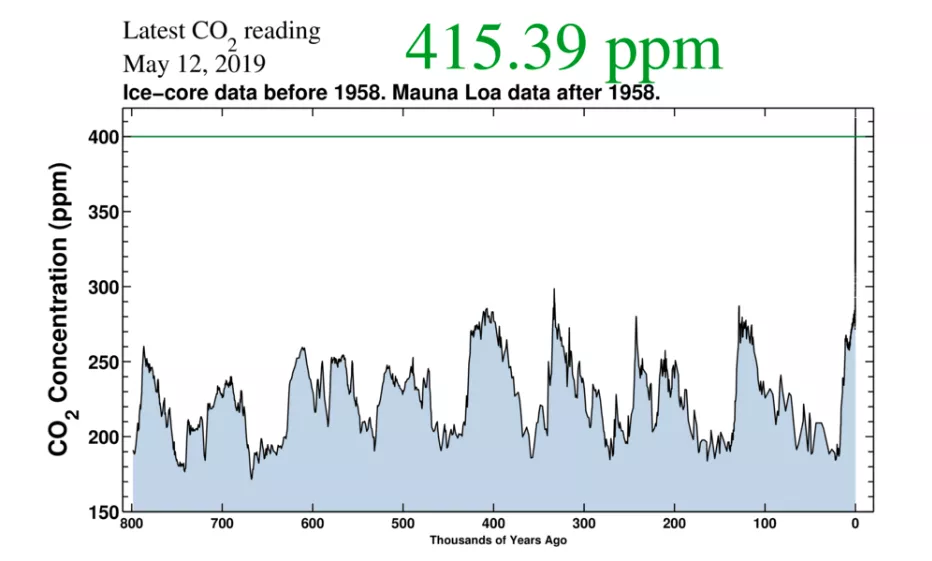
Never before in human history has there been so much carbon dioxide in the atmosphere. The last time scientists believe it may have been this high was 2.5 to 5 million years ago during the Pliocene epoch, when sea levels were 25 meters higher than today and global temperatures were warmer by 2-3 degrees Celsius.
The atmosphere gets hotter until the 2 degree barrier is breached, and all calculations about possible futures enter the nonlinear and non-predictable phase. The world will become unrecognisable.
CO2 is washed in increasing quantity into the oceans, which leads to the further acidification of the oceans. What marine animals will survive, and at what depths is unknown and incapable of being planned for.
75% of the world’s species will be wiped out having not had time enough to adjust their habitat to the new hotter scenario
The ice cap on Greenland will melt, leading to the global seas rising 6 metres in level.
The inhabitants of London, New York, Miami, Shanghai, Seattle, Los Angeles, and thousands of other towns around the world constructed on estuaries will be flooded to a greater or lesser extent.
Civilisation will be threatened as each nation has to try and cope with large internal migrations, by people and families who have lost their only collateral, their house due to rising water levels.
The stress on every national budget is overpowering. Global emigration becomes a thing of the past, as each nation struggles with housing and employing its own people.
But yet immigration will happen because some countries will be so devastated as to be uninhabitable. In this situation war and conflict are inevitable.
The emergence of warlords is a near certainty. They will band themselves in gangs whose only aim is to take what they need for themselves and to hell with everyone else.
Conventional economic theory and economists as a class have not addressed these issues. Lord Stern in the UK is an exception to the rule and he made the following observation.
“Climate change is a result of the greatest market failure the world has seen. The evidence on the seriousness of the risks from inaction or delayed action is now overwhelming. The problem of climate change involves a fundamental failure of markets: those who damage others by emitting greenhouse gases generally do not pay“.
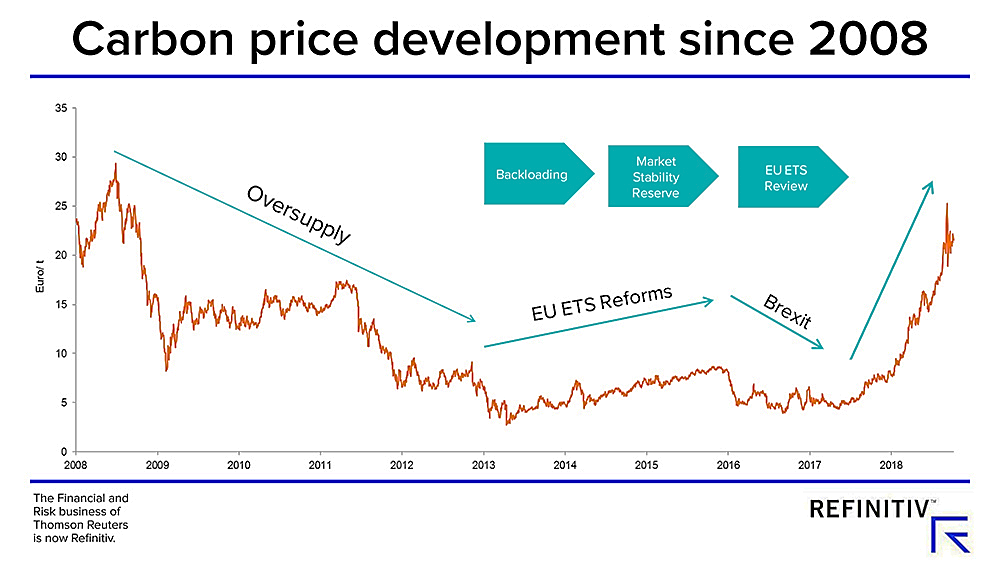
There is a way of looking at the issue of climate change which could be an important input into economic planning. The damage being done to the environment is difficult to quantify, and because so much of it is in the future, costing it in the present is dependent on the discount rate used. Lord Stern has put a cost of $30 to 40 per tonne of CO2 as a fine for emitting the gas. This price is not applied anywhere. The EU emission trading scheme reached low delivered price of €4 to 5 per tonne, which has proved ineffective in changing peoples or companies’ behaviours. The price prices of European Union allowances have more than quadrupled to above €20 after lawmakers overhauled the system’s rules for the period after 2020.
Let us look at the problem another way. What is the true value of a clean unit of electricity? It has 2 values, the utility of the electricity itself plus the fact that it doesn’t emit CO2. Currently only the pure electricity value is recognised. Economists in general only attribute value to the electricity. But is that what Governments should do?
Of course not. If they believe that climate change is the leading threat to our civilisation, and that the thousands of years of history that have happened, and been necessary, to arrive at a democratic, rule of law based, civil society, then it is worth investing to preserve it. Where should this investment be applied?
We need to build the Supergrid to exploit the offshore wind of northern Europe, and the dense solar resources of southern Europe. For balancing purposes it needs to link this northern resource with the solar resource of the south. It will cost somewhere between €1 and 2 trillion, and is additional to the upgrades that will happen to onshore grids to accommodate the additional demand for electricity, which, on a European wide basis demand more than double from 3,500 TWh to 7,800 TWh.
The issue for European Governments can be stated in the following principles:
- As it is a European wide grid that will be provided, the costs will apply to all citizens who will benefit.
- A new regulatory regime will have to be conceptualised to ensure the grid is built at cheapest cost, according to acceptable standards, and in a timely manner.
- There is an urgency about getting the Supergrid built. The snail’s pace at which the national TSOs move will have to be greatly accelerated, so the grid building sector will have to be opened to Independent Grid Builders (IGB) just as the generating sector was opened to Independent Power Provider’s
- The incoming Commission and Parliament has to place the highest policy priority on getting the Supergrid built.
The funding required to decarbonise Europe is there. The renewable resources to harness are present. The technology to generate power in areas of high renewable resources exist today and are only getting better and cheaper. The transmission technology to collect power from the areas of renewable generation exists. The only resource that Europe does not have in abundance is time, which is why we must start now.