
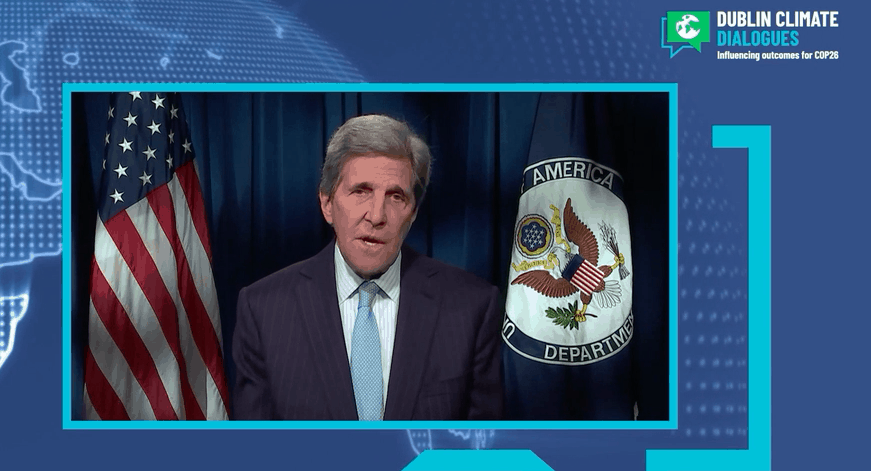
U.S. Special Presidential Climate Envoy John Kerry opened the Dublin Climate Dialogues today, saying that the transition to climate neutrality:
“…is going to be the biggest economic transformation that any of us have seen…Even if everyone in the world – national government, multilateral institutions, companies – hit the current goals on climate and we do so on time that will still not be enough to halt global warming to 1.5 degrees. The truth is, we are just not getting the job done – yet”.
Figure 1: Dublin Climate dialogues Session 1 : U.S. Special Presidential Envoy for Climate John Kerry addressing the conference
The first day of the conference covered an extensive range of topics. Foremost among these was the scale of the challenge presented. This was most evident in the new investment and infrastructure that is required.
There was, however, an air of optimism throughout the discussions, found primarily in the solutions presented. One such source was the collective response and lessons learned from the global COVID pandemic. Another was the opportunities that are expected to arise from the forthcoming electrification and infrastructural overhaul.
A final theme permeating throughout the day’s talks was the concept of a just transition. This is a complex issue but there was consistent reinforcement that we must not leave anyone behind.
Dublin Climate Dialogues Chair, former President of the European Parliament Pat Cox, noted that we must find solutions that focus on:
“protecting the most vulnerable who contributed the least to global warming. We are conducting an unprecedented experiment with the only home that we have – our planet”.
SuperNode Chairman Eddie O’Connor shined some light on the renewable infrastructure sector:
“We have the means to decarbonise without the introduction of exotic new types of generation technologies. There is sufficient wind and sunshine to provide all the energy we need”
Affordable renewable electricity generation is available in abundance, the problem however, in O’Connor’s view, is delivering it to the consumer.
“Renewable energy is location specific. You cannot transport wind and solar. It has to be harvested where it is most available. There is a vast need for new electricity transmission cables,” Eddie O’Connor told the conference, estimating the need for electricity transmission investment to exceed $25 trillion – more than what needs to be invested in generation.
SuperNode are a proud sponsor of the event and another member of the team, Marcos Bryne, who spoke alongside Mr. O’Connor, further outlined the importance of grid infrastructure and the time constraints involved.
“Grid infrastructure is not built overnight, it can take over 10 years from planning to commissioning, and it cannot be an afterthought. The rollout of renewables must coincide with an appropriate long term plan for grid development, which looks at a plan for a decarbonised energy system, and works backwards from this.”
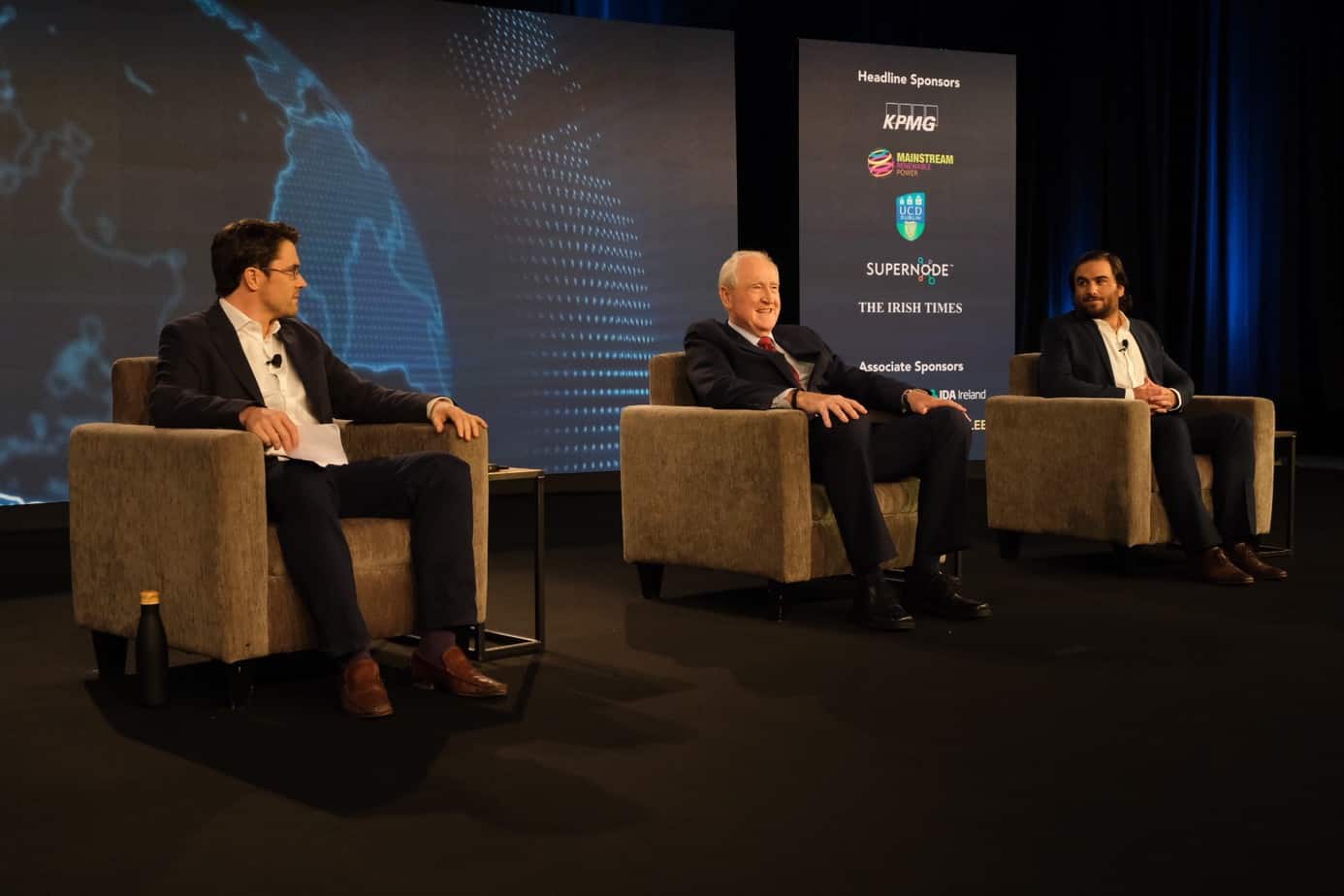
Figure 2: Dublin Climate Dialogues Session 4: SuperNode founder and Chairman Eddie O’Connor flanked by SuperNode CCO Robert O’Connor (left) and Market and Policy Analyst Marcos Byrne (right).
The overall challenge facing the world was described by Prime Minister of Barbados Honorable Mia Amor Mottley who is also serving as Co-Chair of the Development Committee of the World Bank and the IMF:
“We are already too far and too close to the 1.5 degree target to have anything other than the greatest sense of urgency,” she said.
Former Prime Minister of Italy Enrico Letta stressed that solutions must be inclusive and embrace all:
“The green transition must be a just transition. Otherwise we create a conflict between those who worry about the end of the world and those who worry about the end of the month“.
Paschal Donohoe, Minister for Finance, Ireland, and President of the Eurogroup suggested that the current health crisis may have provided lessons to apply to the climate crisis:
“The response to COVID-19 has illustrated our ability to take urgent and decisive action, at international, national and regional level. Indeed, the Covid response has exemplified the critically important role multilateralism has to play in effectively addressing existential challenges,” he said.
Eamon Ryan, Irish minister for the Environment, Climate and Communications talked about his government’s ambition:
“We want to halve our emissions in this decade. To do it we start by making electricity 70-80% renewable by the end of the decade and net zero by the middle of the next decade.”
Electricity is also central to Chile’s plan to decarbonise its economy, which is currently relying on imported coal:
“Our plan is very simple. We are going to replace coal in our electricity grid with renewables. Probably we will be able to phase out coal by the end of this decade,” said Juan Carlos Jobet, Minister for Energy and Mining, Chile. “For example, this year alone we will double our installed solar and wind capacity”.
Dr Fatih Birol, executive director of the International Energy Agency (IEA) addressed the Dialogues the day after having published an analysis establishing what will be needed to reach global net zero by 2050. He mentioned three of the milestones on the pathway to net-zero.
“From this year: no more additional investment in new oil and gas fields or coal mines; no more unabated coal fired power plant can be built around the world. From 2035, no more sales of combustion engine cars”.
SuperNode Chief Commercial Officer Robert O’Connor presented analysis showing that addressing climate change and increasing global welfare are not each other’s opposites.
“There is a net global benefit in the range of $400tn. This is a great outcome. But it requires coordinated improvement in the energy system to be achieved. In practice, this also requires disincentives or penalties for nations and companies who undermine the process,” he said.
Day 1 of the Dublin Climate Dialogues brought together a collection of distinct voices and produced healthy debate, all of which will contribute to the declaration that will be presented to the COP Presidency in the final session tomorrow.