

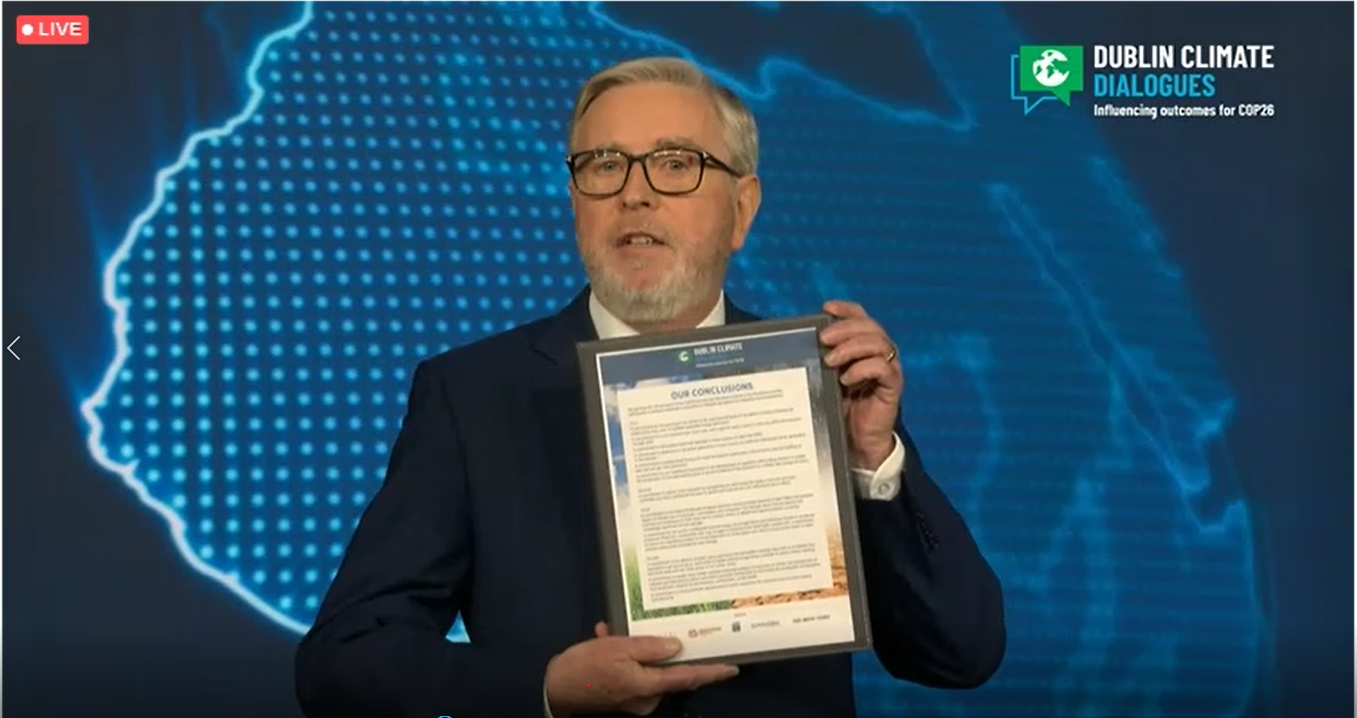
Day 2 of the Dublin Climate Dialogues took a more technological approach to the Climate Crisis. It culminated in former President of the European Parliament, Chair of the Dublin Climate Dialogues and SuperNode board member, Pat Cox formally presenting the carefully forged Declaration over to John Murton of the COP26 Presidency.
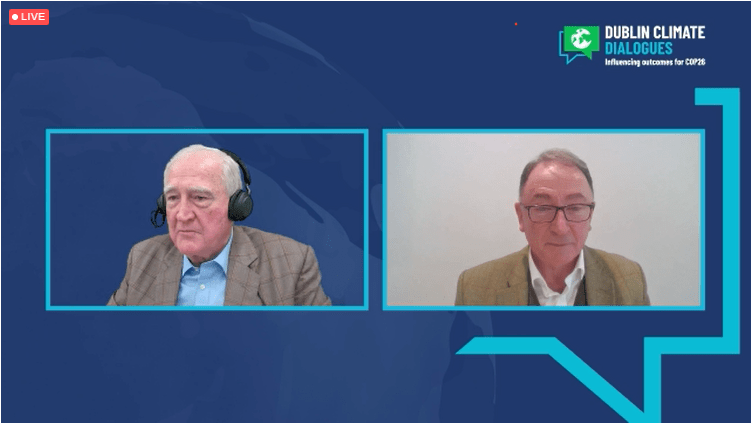
In the scene setter for the day, SuperNode founder and Chairman Eddie O’Connor discussed the age of electricity with President of the Royal Academy of Engineering and Principal and Vice-Chancellor of the University of Strathclyde Sir Jim McDonald. The crucial role electrification must play in decarbonisation has been a recurring theme over the two days. Sir Jim pointed out that investment into grid infrastructure is at least as important as investment into renewable generation. He touted the merits of new grid systems from micro grids to international SuperGrids. He went on to discuss the possibility of superconductivity revolutionising the industry:
“Superconductors are very promising materials. They are game-changing opportunities (…). For example long-distance compact DC superconducting cables will enable loss-free transmission. There is a game changer in cost”.
Figure 1: Eddie O’Connor (left) with Sir Jim McDonald
Session 7 followed with a look at which technologies are going to get us to decarbonisation. Gerard Reid of Alexa Capital gave an impressive overview of the seven most critical areas, including electrification, storage and digitilisation.
Mainstream CEO Mary Quaney went on to outline the revolutionary nature of the infrastructure requirements over the coming decades:
“Last year was a record year for the installation of wind and solar power plants – but – we need to double, and then treble, and then quadruple this build out”
In order to accomplish this level of infrastructure, the declaration recommends a commitment by multilateral Institutions to the development of regulatory and funding solutions to enable the acceleration.
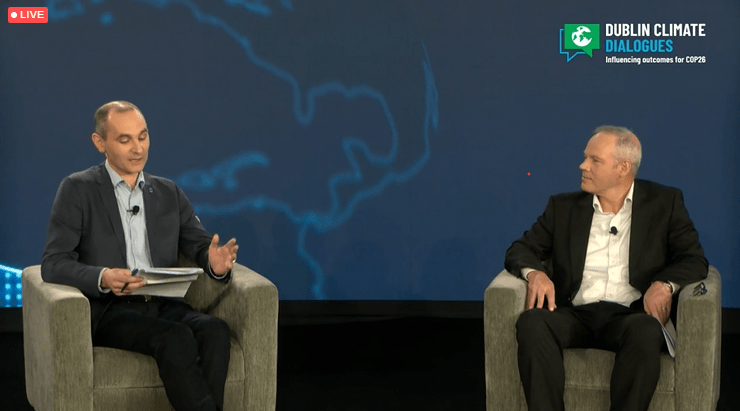
Session 8, the final session of the conference was a panel discussion on ‘Energy Systems to Facilitate Decarbonisation’. The panel consisted of industry members from China, the U.S., the European Parliament and ENTSO-E as well as SuperNode CEO John Fitzgerald.
A core message from the panel was just how much energy systems will need to change if we are to accomplish decarbonisation. The current system will not be enough nor will minor tweaks. A major overhaul will be necessary to accommodate the increased level of renewables and electricity systems must integrate with the rest of the energy infrastructure.
French Member of the European Parliament Marie Toussaint (Greens) spoke of her proposal to create an Independent Energy Infrastructure Council (EIC), made in the current negotiations in Brussels on revising the trans-European Network for Energy – a framework for promoting infrastructure projects with cross-border impact.
“We need a science-based approach and an independent approach with the participation of the citizens. I propose a balanced and independent Energy Infrastructure Council,” she said, arguing that the gas and electricity system operators as asset owners are not independent.
The proposal for an independent technical body such as the proposed Energy Infrastructure Council (EIC), was welcomed by Mr. Fitzgerald. This body would look towards 2050, planning new European energy infrastructure inclusively and unbiasedly, independent of assets.
“With regards to the TEN-E regulation, there needs to be provision in there for a plan and I really welcome Marie’s and the European Parliament’s Environment Committee’s proposal on an independent Energy Infrastructure Council. A body without assets, represented by stakeholders that can identify the infrastructure and innovation gaps and map out a plan to take us all the way to 2050,” Mr. Fitzgerald said.
Another problem with the TEN-E framework is that it does not sufficiently address the need for grid innovation.
“There is a presumption that transmission technology is where it needs to be. It’s not. And that’s probably the single biggest threat to achieving a renewables powered electrification that all here agree is needed,” Mr Fitzgerald said.
Rob Gramlich of Grid Strategies LLC, spoke of the new tone on climate and transmission in the U.S. borne from the Biden and Harris Administration.
Figure 2: SuperNode CEO John Fitzgerald (right) during Session 8
The Declaration
Proceeding session 8, the Declaration was officially presented to John Murton, UK COP26 Envoy. The declaration seeks to capture the essence of the two days of discussion and outlined 4 recommendations for COP26.
First
A commitment to global electrification and an annual quadrupling of renewable generation installations.
A Commitment to transition away from fossil fuels with plans in place for every country by 2025 and execution by 2030.
A commitment by multilateral institutions to the development of regulatory and funding solutions to enable the acceleration of new grid infrastructure.
Second
A commitment to deliver a just transition by recognising and addressing the needs of poorest and most vulnerable who have contributed the least to global warming but who risk suffering its worst effects.
Third
A commitment to rapidly introduce global reporting and accounting measures to boost transparency and further protect our countries, communities and companies . This includes stress testing institutions to better prepare them for the coming climate induced shocks.
Furthermore, multilateral financial bodies, the private sector and individual citizens should accelerate the flow of investment into communities who wish to build climate resilience based around clean energy.
Fourth
A commitment to deliver public policy pathways that will enable countries who wish to accelerate the transition to net zero, including the encouragement of international cooperation at every level.
Also recommended is a commitment to the enablement of cross border solutions in the form of strong prices on carbon, national and international carbon price floors and carbon border adjustments.
Figure 3: Pat Cox with the official Declaration of the Dublin Climate Dialogues
The Dublin Climate Dialogues ended with some closing remarks from the Chair of the event Pat Cox. He issued a stirring call to arms for all those who wish to safeguard our future:
“This is not someone else’s problem, it is ours. We are not by-standers. Each in our own way is an actor in this great human and planetary drama.”
The Declaration is made up of two documents – The first has 4 recommendations which can be found here: The Dublin Climate Dialogues Declaration Conclusions
The second fleshes out the recommendations and the themes discussed over the course of the Dublin Climate Dialogues: The Dublin Climate Dialogues Declaration