

The context, apart from a rapidly warming planet, is that the meetings in December 2018 in Katowice in Poland aim to take the whats from the 2015 Paris Climate Accord, and turn them into hows, specifically for financing – how much should more developed nations contribute vs developing nations?
“Limiting global warming to 1.5ºC would require rapid, far-reaching and unprecedented changes in all aspects of society…” but “… limiting global warming to 1.5ºC compared to 2ºC could go hand in hand with ensuring a more sustainable and equitable society.” – IPCC Special Report Press Release, October 2018.
The IPCC special report on the impacts of global warming of 1.5 °C above pre-industrial levels and related global greenhouse gas emission pathways, in the context of strengthening the global response to the threat of climate change, sustainable development, and efforts to eradicate poverty.
If your time is tight, here are some nuggets from the technical summary;
“Human-induced warming reached approximately 1°C (±0.2°C likely range) above pre-industrial levels in 2017, increasing at 0.2°C (±0.1°C) per decade (high confidence)”
“Depending on the temperature dataset considered, 20-40% of the global human population live in regions that, by the decade 2006-2015, had already experienced warming of more than 1.5°C above pre-industrial in at least one season (medium confidence)”
“If all anthropogenic emissions (including aerosol-related) were reduced to zero immediately…A warming greater than 1.5°C is therefore not geophysically unavoidable: whether it will occur depends on future rates of emission reductions.”
“Very different impacts result from pathways that remain below 1.5°C versus pathways that return to 1.5°C after a substantial overshoot”
“Under emissions in line with current pledges under the Paris Agreement (known as Nationally Determined Contributions or NDCs), global warming is expected to surpass 1.5°C, even if they are supplemented with very challenging increases in the scale and ambition of mitigation after 2030 (high confidence)…and…Available pathways that aim for no or limited (0–0.2°C) overshoot of 1.5°C keep GHG emissions in 2030 to 25–30 GtCO2e yr-1 in 2030 (interquartile range). This contrasts with median estimates for current NDCs of 50–58 GtCO2e yr-1 in 2030″
“Pathways that aim for limiting warming to 1.5°C by 2100 after a temporary temperature overshoot rely on large-scale deployment of Carbon Dioxide Removal (CDR) measures, which are uncertain and entail clear risks.”
We’ll stop there with the quotes….
This is one of the most important studies for the future (and present) of humanity, building on the work of the Fifth Assessment in 2014.
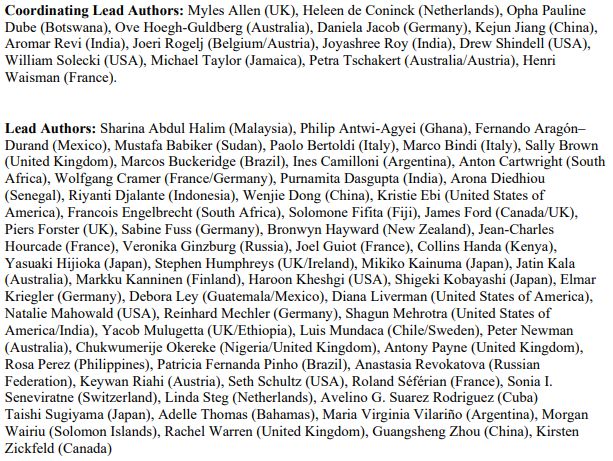
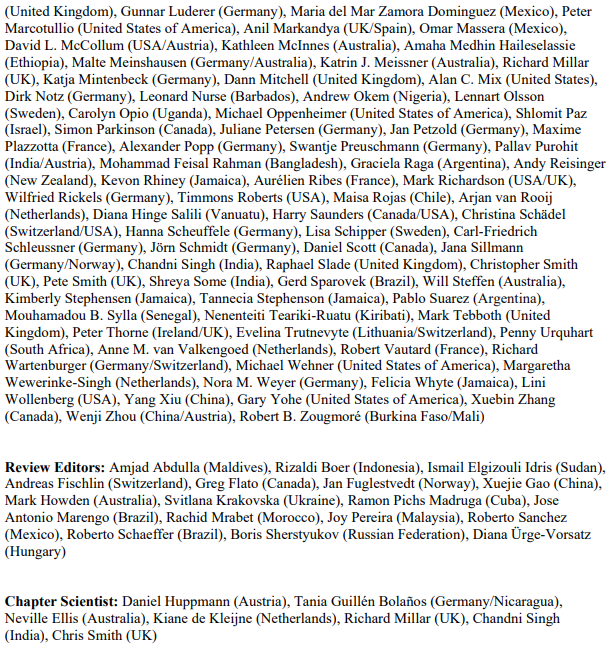
It is important to remind ourselves of the scope of this study and its contributors;

Thank you all for your work!
Note – As the impacts of a warmer world fall disproportionately on the poor and vulnerable, here is an informative site on knowledge around UN 2015 Sustainable Development Goals by IISD