

An interconnected pan-European energy system can reduce costs by up to 39% when compared to a Business-as-Usual approach, according to a model produced by UCD with further analysis from SuperNode.
The new sensitivity analysis was presented at Engineers Ireland on 1st of March by SuperNode Market and Policy Analyst Marcos Byrne and Director of the UCD Energy Institute Andy Keane. The original model was launched by UCD in early 2022 which stated that a cost reduction of 32% could be reached. However, further analysis by SuperNode of the original model via an expansion of the sample size, 5 years instead of just 1, has shown that a cost reduction of between 32% – 39% could be achieved versus a Business-as-Usual approach.
“A key result is that the Business-As-Usual approach is not fit for purpose….The study demonstrates the net benefit of large investment into the development of new transmission assets.” said Andy Keane during his presentation.

Marcos Byrne who led SuperNode’s analysis said:
“The latest analysis further proves the need for Europe to begin planning an interconnected European-wide Supergrid based around the specific characteristics of renewable energy. Renewable resources can be optimised by locating them where the resource is strongest and complementing them with long duration storage and innovative grid technologies like lossless superconductor cables. A Business-as-Usual approach to Europe’s grids will be prohibitively expensive to the success of our decarbonisation and energy security goals.”
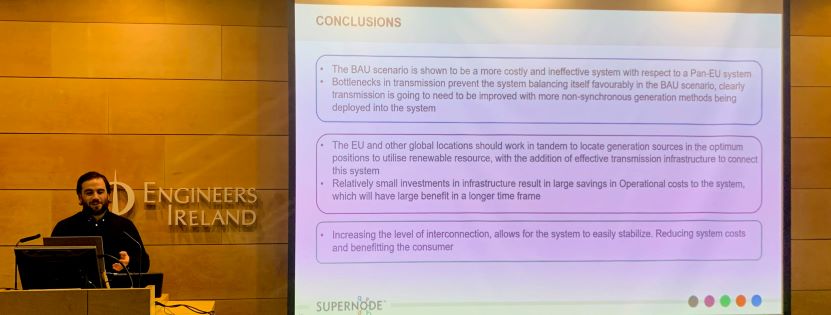
The study evaluates the capabilities of Europe’s transmission system based on the SuperNode Energy Scenario for Europe 2050[1]. This scenario predicts future energy trends and was validated and extended by the UCD study.
The cost reduction identified is borne primarily from the expansion of European power flows. Derestricting power flows will allow the location of renewable generation to be optimised thus significantly decreasing the total installed capacity. While this scenario proposes an increase in transmission capacity, the costs are insignificant when compared to the cost savings in generation investment over the same period.
Another feature of the new analysis tested the effect of a lower cost of storage on each of the scenarios for the original sample year. The cost of storage was halved in both scenarios and while overall cost reductions were found in both, there was a three time larger cost reduction in the Pan-European scenario compared to the Business-as-Usual. Thus, a significant reduction in the cost of storage actually benefits a pan-European approach more than the Business-as-Usual. This further strengthens the case for a fully integrated pan-European energy system.
Here is a full recording of the study being presented at Engineers Ireland
Here is a link to the new sensitivity analysis performed by SuperNode: Sensitivity Analysis Report
The original study, divided into two parts is available as follows:
Part 1: The Future Energy Scenarios and the Power Flow Tool
Part 2: Analysis of the Tool’s Output
[1] SuperNode Energy Scenario for Europe 2050 , link includes short version and long version