
John Fitzgerald, CEO

David McWilliams outlines the vast renewable energy potential located in the Irish offshore space in his Irish Times article: “Donegal to Dingle could become the world’s most innovative energy hub”. The article even goes so far as to say:
“In the 21st century, Ireland is to renewable energy what 20th century Saudi Arabia was to fossil fuels.”
This is a bold yet entirely true claim. Ireland, however, along with the rest of Europe are dragging their feet and now risk falling behind other states such as China and the US. Europe is stuck debating over the use of fossil fuels despite the already mature renewable energy industry in place.
Renewable generation technology, such as wind turbines and solar PV, is already fit-for-purpose to power a decarbonised Europe. The biggest challenge is designing and developing an innovative electricity grid to accommodate the specific characteristics of renewable energy.
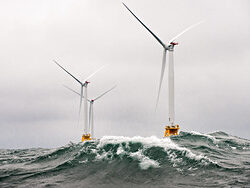
Renewable energy is heavily influenced by climate which in turn is dependent on geography. The greatest wind resources are offshore. Wind speeds are higher than on land, where friction reduces them. The average capacity factor since wind installations began on land in Ireland, and which in turn is driven by wind speed, is 32.5%. The average capacity factor in the North Sea is 55%. In future, in deeper waters, using floating technology, the capacity factor will be 65%. The average size of “on land” wind farms is around 20 megawatt (MW), whereas the average offshore wind farm is 1,000MW.
As basically all transport is being electrified and likewise heating and cooling, demand for electricity in the EU will triple over the coming three decades. Some 900,000 MW will need to be constructed offshore. A similar amount of solar PV will need to be constructed, to decarbonise Europe’s economies.
This realisation turns the European energy procurement into a European wide proposition, as distinct from a national or regional one. We no longer will be able to transport the oil, coal, and gas from where it is mined to some local, nationally suited location. Wind and solar must be harvested where they deliver greatest bangs for the buck and the generated electricity transported to where the people need it and consume it.
Most inland European countries are short of renewable sources of energy. The peripheral regions to the north-west and south are rich.
Because of this and the need to smooth out fluctuating renewable sources of power, Europe needs a Supergrid. All electricity systems since Thomas Edison have needed a grid.
If we are to decarbonise sustainably in less than three decades, at minimum cost, Europe needs a European-wide electricity grid. The current barely interconnected, mish-mash of independent systems, relying for the most part on fossils can never affect decarbonisation. The planning for this infrastructure has to begin immediately and must become a main government priority of the European Union, its member States plus the UK and Norway. In fact, it is difficult to imagine a higher political purpose for these governments to undertake in their common fight against global warming.
Europe and Ireland with it should be preparing its electricity infrastructure for a carbon free future based on weather-dependent technologies. Still, its leaders seem trapped in a continual debate about the role of, and subsidies to, fossil fuel infrastructure, as evidenced by the latest meeting of EU energy ministers in Luxembourg on 11 June. It is time to change focus, and pace.