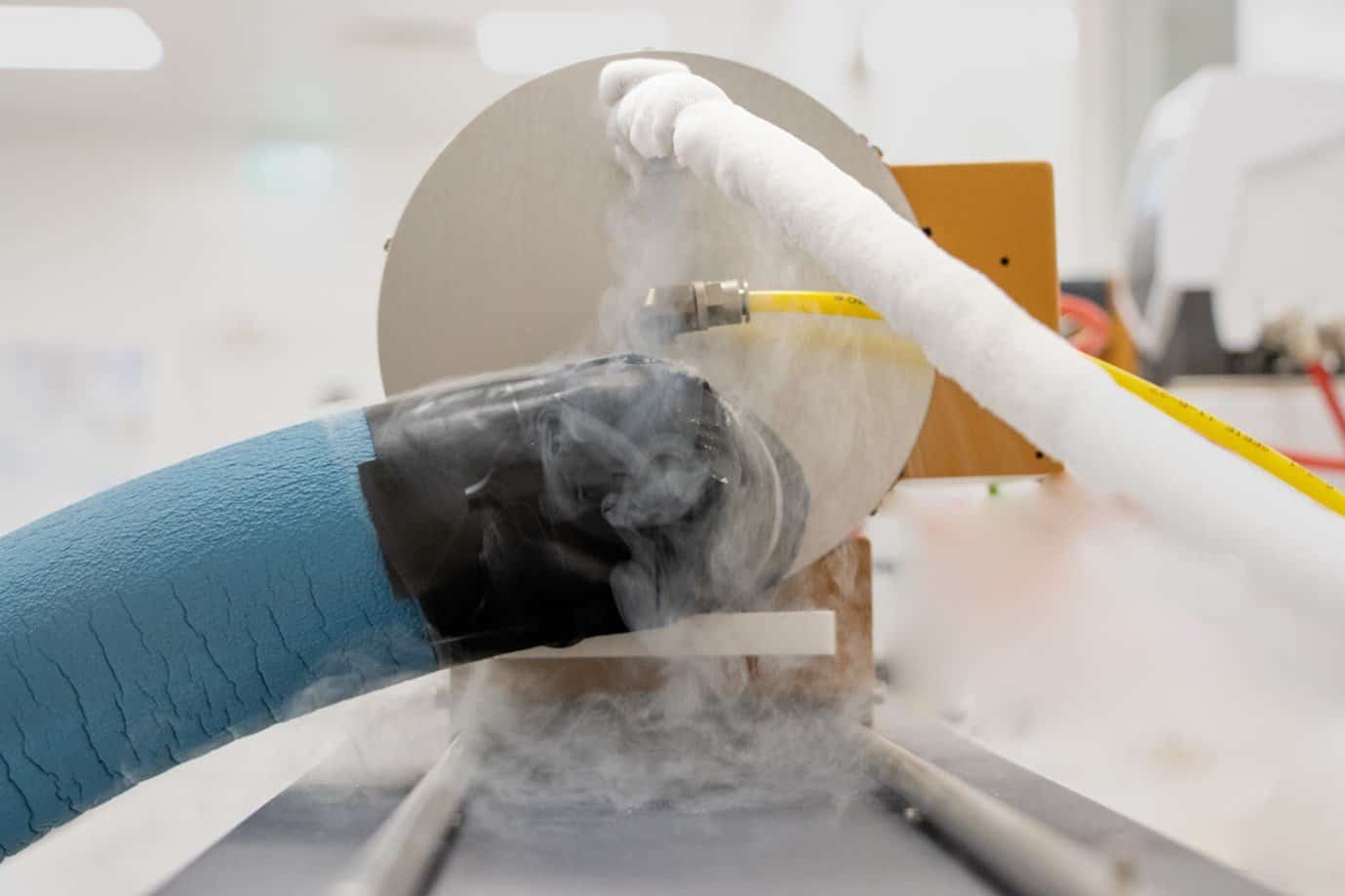

An interview with Chief Engineer Eoin Hodge
Q: Can you tell us a little bit about the role that dilatometers play in the research and development efforts at SuperNode Ltd?
A: The dilatometer is a crucial tool for us in our work on superconductor cable technology. It allows us to measure the dimensional change of materials when they are subjected to cryogenic temperatures, which is critical information for our engineers as they develop innovative new materials and manufacturing processes to improve the performance of our cables.
Q: How does the dilatometer work and what kind of materials can it be used to test?
A: The dilatometer consists of a cryogenic sample chamber, a heating element, and a displacement sensor. The cryogenic sample chamber holds the material being tested, and the heating element can be used to raise the temperature of the material to desired levels during testing or after a cryogenic test. The displacement sensor measures the dimensional changes of the material, allowing us to determine its thermal expansion properties. We can test materials under a wide range of conditions, from higher temperature to -200 degrees Celsius, to optimise their suitability for use in our superconductor cables.
Q: What do you find most interesting about the dilatometer and its role in your work?
A: I think it’s fascinating to understand complex material dynamics as they are heated and cooled to our technology’s operating ranges. The dilatometer provides a physical validation of the principles of thermal physics and verification of the thermo-mechanical models we have developed to characterise the novel materials under development in SuperNode. But beyond the material’s science, the dilatometer is an important tool for us in our ongoing efforts to develop and improve our superconductor cable system technology. We are grateful to have access to this sophisticated piece of equipment and very excited to deploy it, as we continue to push the boundaries of what is possible in material’s cryogenics and its application to our technology.