

Global consensus is growing that we will need continental scale Supergrids to enable the renewable powered energy systems of the future. This is evident from sources around the world, from a study by German TSO TransnetBW [1], Wind Energy Ireland’s Supergrid Position paper [2], the ‘Asia Supergrid’ as proposed by the Renewable Energy Institute back in 2014 [3] and most recently Bloomberg’s video on the subject: ‘Global supergrids could be the future of Energy’ [4]. The proliferation of the Supergrid concept is encouraging and much of the messaging is extremely valuable. However, as will be broken down in this article, Supergrids are a novel concept and the Bloomberg video shows there still remain some inaccurate assumptions that must be recognised if we are to successfully deliver Supergrids in time.
The Supergrid
The Bloomberg video has come to the right conclusion on overall grid planning, in that our grids as currently constituted will not be able to accommodate renewables at the levels needed to decarbonise. And so we need a new approach to grid planning, one designed around the characteristics of renewable energy. We need a Supergrid.
The first challenge of renewable energy is that we cannot just replace fossil fuel generation plants. Renewable generation must be located where the resource is strongest, as Bloomberg puts it:
“We also need to build infrastructure that can move huge amounts of electricity over long distances, transferring power from the windy and sunny places where it’s generated to the population centers where it will be used.”


Figure 1: Offshore wind farm Figure 2: Desert solar farm
A Supergrid would overlay current national grids, which still function as normal, and act as motorways for moving very large amounts of power long distances, both onshore and offshore.
A Supergrid would also solve the crucial variability / intermittency challenges presented by renewables. We cannot control when the wind blows or sun shines in the same way we can turn on or off a coal plant. This creates huge challenges for countries trying to decarbonise individually. A Supergrid would cover a large enough area to balance the variability of the weather and would ensure that every region is adequately connected to productive renewable resources at all times, regardless of the local weather.
This is particularly advantageous for some regions. In Europe for example, the production of wind and solar is negatively correlated and ergo complementary. European wind generation, located primarily in the North, peaks in winter when solar generation, located primarily in the South, is at its lowest and vice versa. So connecting up these two regions, via an interconnected European Supergrid, can provide more consistent renewable energy all year long.


Figure 3: Wind and solar generation in Europe, source IEA Figure 4: Representative European Supergrid
Without a Supergrid, some countries will be left with limited renewable resources, and even those with an abundant resource will inevitably fall victim to occasional days when there is no wind or sun. If acting alone, countries will be forced to over-install renewable generation in sub-optimal locations to try to maximise power from their own national sources. A study of the US grid performed by Bill Gates-backed Breakthrough Energy found that a national or regional US grid would need to install 30% less renewables overall compared to a state-by-state approach, saving significant costs [5].
Limited grid cooperation will also lead to significant curtailment of renewable energy production. For example in 2020, Ireland produced 36.4% of its electricity from wind energy but lost 12.1% of that wind energy due to grid inadequacies and curtailment. Without interconnections providing a route to external markets, building more renewable generation will lead to more curtailment losses.
This kind of insular, national approach will also cause an overreliance on storage and an increased level of dispatchable power, often from fossil sources. All of this results in a very inefficient, expensive energy system with a significant environmental footprint. This approach simply will not deliver decarbonisation in time.
Supergrids Today
It is clear that we need these Supergrids, and to some degree progress has been made, most notably in Europe and China.
As Bloomberg points out, Europe already has some level of interconnection between countries and the EU has now set an interconnection target of at least 15% by 2030. But as it stands today, we are still far from the level we need to be. Furthermore, most current interconnections and those planned for the near future are point-to-point. This will not be sufficient for a truly interconnected European Supergrid. For a Supergrid to be truly effective, it must also be meshed, providing multiple routes to multiple markets with the ability to efficiently direct power from supply to demand.

Figure 5: Map of Europe’s Transmission Lines 2019, ENTSO-E
China too, already has the beginnings of a Supergrid. China has installed Ultra-High Voltage Direct Current overhead lines capable of transferring enormous amounts of power from one side of the country to the other. The most notable of these is the Changji-Ququan line. This is an overhead line which operates at 1,100kV and can transfer 12GW of electricity 3,293km from the west of China to just outside Shanghai on its east coast. This requires massive infrastructure on a scale not possible in many regions outside of China due to geographic and political dynamics. Moreover, the Chinese UHVDC grid is also point-to-point, rather than meshed.


Figure 6: UHVDC lines in China Figure 7: Chinese ultra- HVDC pylon
Overhead Lines are too hard to build
The nature of the grid infrastructure we are installing today is creating huge difficulties. In much of the world, overhead transmission lines are extremely difficult to build due to public opposition. The scale of infrastructure as seen in figure 7 is staggering and is just not feasible in most regions outside of China.
Bloomberg addresses this issue from a US context. They outline how difficult it is to gain permitting rights from landowners, as it takes just one landowner to object and potentially add years of delays to a project. The case study of the Transwest transmission line is explored. The proposed line would carry 3GW over 1,126km from Wyoming to Vegas. Construction on the line is finally due to start after spending 17 long years in development. Currently in the US, 500GW of solar, 200GW of wind and 200GW of storage across 5,600 unique projects are stuck in transmission interconnection queues [6].
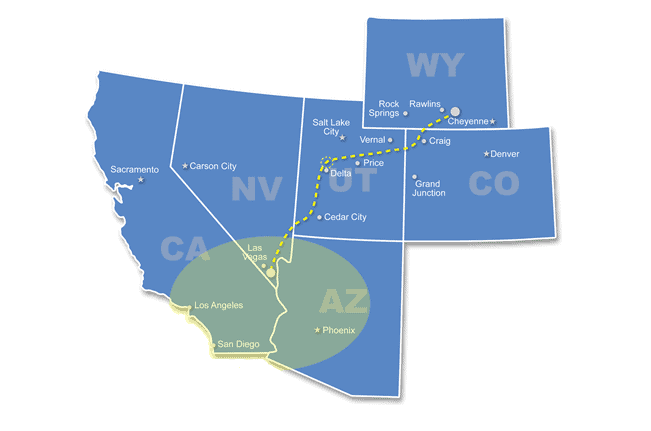
Figure 8: Transwest transmission line
This is a huge challenge for transmission grids and the key to overcoming this challenge and minimising public opposition is to build as much of our transmission grids offshore or underground.
Political barriers
Bloomberg also explains how the political tensions between nation states act as a significant barrier to international cooperation on Supergrids. Bloomberg highlights the strained and highly competitive relationships between Asian countries like China, Japan and Korea which are hindering an Asian Supergrid. And even within the relatively strong relationships of the European Union, each country still has its own individual energy grid working towards its own set of priorities. To make matters worse, the Russian invasion of Ukraine has highlighted the dangers of relying too heavily on foreign energy supplies. In Europe this does seem, so far, to be strengthening a cooperation towards a renewable energy system but the overarching message may still carry weight around the globe, at a time when international cooperation is so critical to combatting climate change.
The challenges of conventional cables
There is, however, a critical detail that Bloomberg and many others are overlooking. In that there has been a lack of appropriate evaluation of the power flows that will be needed in the long run and following that an assessment of the transmission system and technology that will be needed. Instead there is simply an acceptance that we should use the next generation of already established grid technology (HVDC). This is a common incrementalistic mistake.
Bloomberg assumes that HVDC cables which are being installed today will be capable of transmitting the necessary power flows of the future. There are a number of problems with this assumption.
The current state-of-the-art HVDC technology is 525kV copper cables (SuedLink, Germany) and 800kV cables have been touted as the next advancement and are predicted to be technically feasible by 2050.
Although the previously mentioned Chinese UHVDC line operates at 1100kV, this is an overhead line. The prospect of underground or subsea cables operating at voltage levels of 800kV+ would require extremely large and expensive transformers and offshore platforms. The materials, space and cost required for this scale of infrastructure would be a significant barrier, presenting many of the same public opposition problems as overhead lines and it would simply not be economically compatible with a successful decarbonisation.
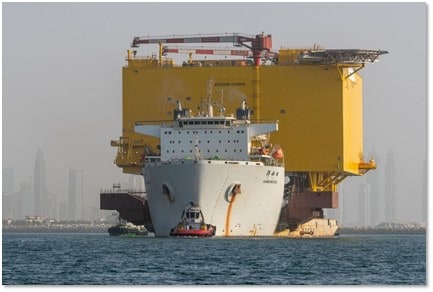
Figure 9: Borwin3 offshore platform being transported from Dubai to the North Sea, 900MW, 18,500 tonnes
HVDC technology’s reliance on copper as a conductor will also prove a major challenge. Copper has become a major industrial metal, ranking third in terms of quantities consumed (behind iron and aluminium). Copper usage has skyrocketed in recent years due to the energy transition. Copper is used in everything from construction, kitchen appliances, computers, and mobile phones and is now critical to the rise of electrical vehicles, charging infrastructure, solar PVs, wind turbines, batteries and of course power transmission.
As copper demand continues to grow, supply will struggle to keep up. The price of copper has been rising consistently since 1980 but has taken a more dramatic increase recently. The price has risen from $2.17 per pound in March 2020 to as high as $4.94 in February 2022. Copper pricing has long been sensitive to business cycles and has proven a volatile commodity. If a Supergrid is to succeed and be powered by HVDC cables it will require enormous amounts of copper, in fierce competition with other critical energy transition technologies and will be particularly vulnerable to supply/pricing risks.
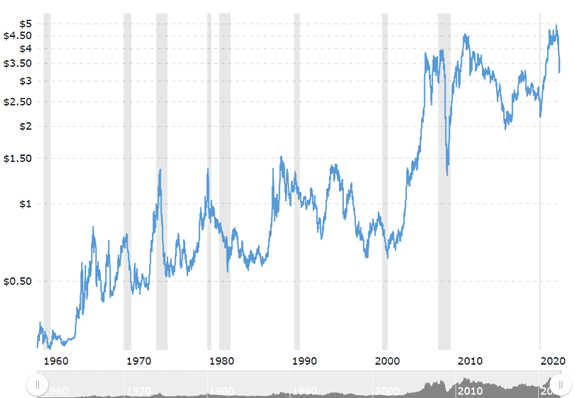
Figure 10: Historical Copper Prices, Grey shading indicates recessions, Source: Macro Trends
Another drawback of HVDC underground and subsea cables is that they are simply too capacity constrained for a renewables based energy system. 525kV copper cables are capable of carrying 2GW of power while 800kV cables are predicted to extend the capacity to 3.5GW. These capacities will not be enough. An efficient and effective Supergrid transmitting renewable electricity from offshore wind farms and across country borders will require transmission cables capable of carrying capacities of 4GW, 6GW, 8GW and even up to 10GW, as already occurs in China. If Supergrids are to become a reality, it is critical that we develop new innovative cable technology that can efficiently transfer power at much higher power capacities.
Superconducting cables are the solution
Superconducting cables are that new innovative cable technology, that can be the final piece to the complex puzzle that is the Supergrid. Superconducting cables harness the characteristics of superconductivity. This is a phenomenon that occurs in certain materials that when cooled below their critical temperature (-180 degrees for high temperature superconductors), display a number of unique characteristics including zero electrical resistance, high power density and a low electromagnetic field. Superconducting cables can be made from various materials and complex compounds which replace copper as the conductor.
The high power density of superconducting cables means they can transfer extremely high levels of power, up to 10GW, and at lower voltages than traditional conductors. The Best Paths Superconducting demo project operated a 6.4GW line at 320kV, which is already an established DC cable voltage.

Figure 10: Marine superconducting cable
Superconducting cables are operational today at a distributional level, primarily solving grid issues in densely populated urban areas e.g. Shingal Project in Seoul, South Korea, Ampacity Project in Essen, Germany and the upcoming SuperLink in Munich, Germany. SuperNode is developing superconducting cable systems at a transmission level for connecting offshore wind farms and interconnections between countries.


Figure 11: Comparison of offshore platforms Figure 12: Terrestrial cable corridor comparison
Superconducting cables usage of lower voltages reduces the need for larger footprints and more expensive infrastructure like converters, transformers and offshore platforms. Superconducting cables require much less space, materials (especially copper) and infrastructure than conventional cable technology and can transfer power with zero electrical losses. This means superconducting cables can facilitate the required level of power flows for a renewables powered system, while increasing efficiency and decreasing costs. They can be built offshore and underground decreasing the risk of public opposition and overall having a much smaller environmental footprint.
SuperNode’s superconducting cables will be the key to unlocking the renewable powered Supergrids of the future.
[1] https://www.energysystem2050.net/
[2] https://windenergyireland.com/images/files/supergrid-report-march2022-final.pdf
[3] /asg/about/
[4] https://www.bloomberg.com/news/articles/2022-07-28/video-global-supergrids-could-be-the-future-of-energy-if-we-let-it
[5] Gates, B. 2021, How to avoid a climate disaster: The solutions we have and the breakthroughs we need, Penguin.
[6] https://www.energize.vc/news-insights/electrifying-everything-it-all-comes-down-to-transmission